SARE GRANT PROJECT
Virtual Fencing vs. Net Fencing: Measuring Labor Savings and Grazing Efficiency on a Small Ruminant Farm in Rural Maine
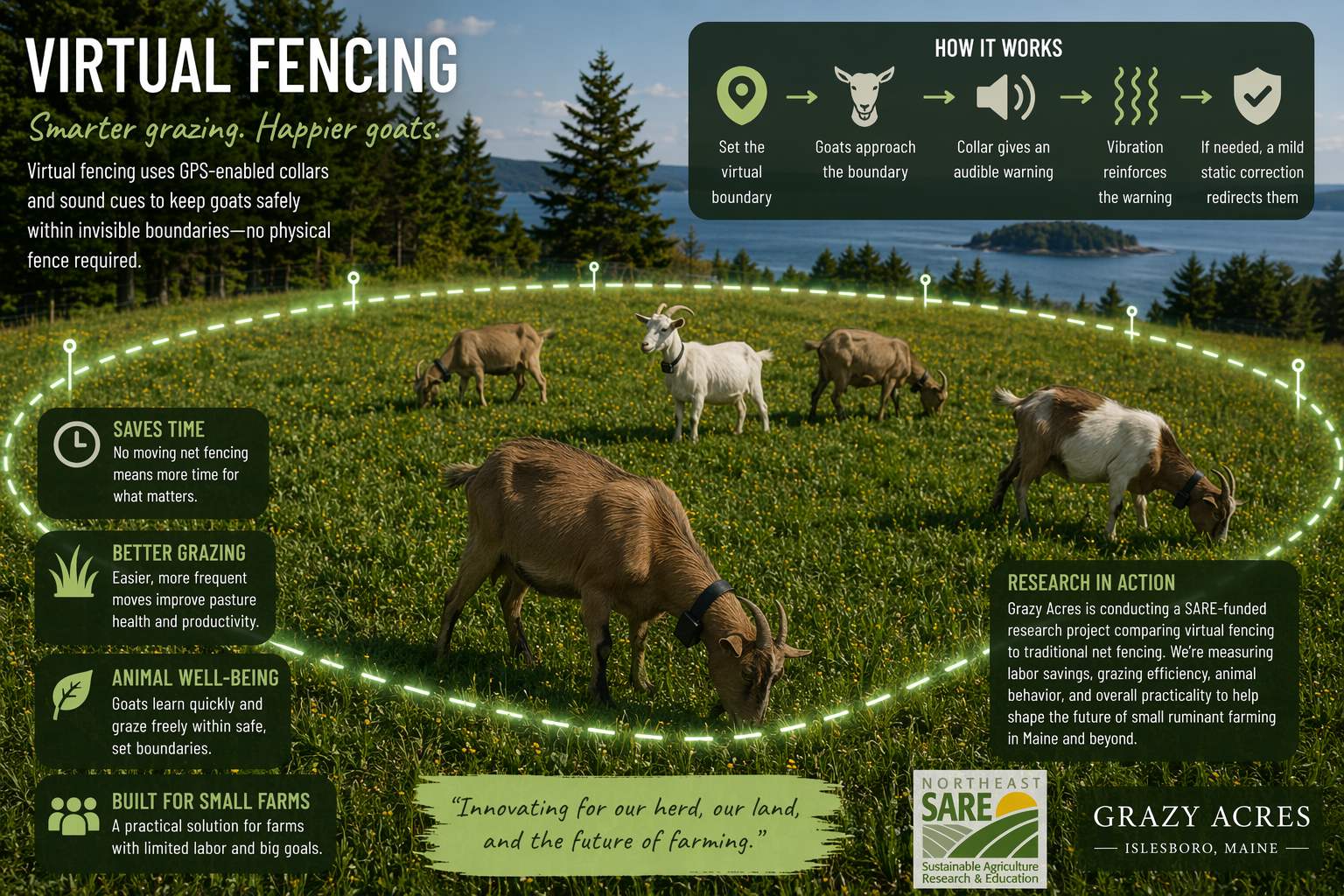
At Grazy Acres, we are always looking for ways to improve how we farm—making our systems more efficient, sustainable, and realistic for small-scale operations. Through support from the Northeast Sustainable Agriculture Research and Education (SARE) program, we are conducting a two-year research project focused on one of the most time-consuming aspects of livestock farming: fencing.
PROJECT OVERVIEW
Traditional rotational grazing relies on portable electric net fencing, which must be regularly installed, moved, and maintained. While effective, this system is labor-intensive and can limit how frequently animals are rotated—especially on small farms where time and labor are already stretched thin.
Our project is evaluating virtual fencing technology as an alternative. Using GPS-enabled collars, virtual fencing allows livestock to be contained and moved without the need for physical barriers.
This study directly compares:
Traditional electric net fencing
Virtual fencing systems
…to better understand how each approach performs in a real-world, small farm setting.
Virtual Fencing with NoFence
As part of our SARE-funded project, Grazy Acres is utilizing the NoFence Virtual Fencing System to explore a new approach to grazing management.
NoFence uses GPS-enabled collars that allow us to create virtual pasture boundaries without the need for traditional physical fencing. Animals are guided by audio cues and mild, safe stimulation, learning to stay within designated grazing areas.
This technology allows for:
Greater flexibility in pasture rotation
Reduced labor associated with fence setup and movement
Access to previously hard-to-graze areas
More efficient and responsive grazing management
Through this project, we are measuring how virtual fencing compares to traditional electric netting in terms of labor savings, grazing efficiency, and overall farm management.
WHY THIS MATTERS
For farms like ours, labor is one of the biggest constraints. Time spent setting up and moving fencing takes away from other essential tasks—from animal care to product development.
This project aims to determine whether virtual fencing can:
Reduce daily labor demands
Increase grazing flexibility and rotation frequency
Improve pasture utilization
Support more sustainable and scalable grazing practices
By testing this technology on a working farm, we hope to provide practical insights that other farmers can use to make informed decisions.
What We’re Measuring
Over the course of the project, we are tracking:
Labor hours required for each fencing system
Grazing efficiency, including pasture use, regrowth, and overall pasture health
Animal behavior and adaptability
Ease of use and system reliability
Overall cost and practicality for small farms
Pasture health, including forage height, recovery time, and long-term soil impact
This data will help paint a clearer picture of how virtual fencing performs beyond theory—under real conditions, with real constraints.
Our Farm’s Role
As a small, island-based goat dairy, Grazy Acres is uniquely positioned to test this system in a challenging and resource-limited environment. Like many farms in Maine and across the Northeast, we operate with limited labor and a need to maximize both time and land use.
In addition to this research, Grazy Acres:
Raises a diverse herd of dairy goats, including rare registered Guernseys
Produces value-added micro-dairy products
Offers goat herd rentals for land clearing
Focuses on sustainable, adaptable farming practices
This project is a natural extension of our commitment to innovation and long-term farm viability.
Sharing What We Learn
A core component of the SARE program is farmer-to-farmer education. Throughout this project, we will be sharing updates, observations, and results through:
Social media updates
On-farm demonstrations and conversations
Final reporting and outreach events and supporting materials
Our goal is to make this information accessible and useful—not just for researchers, but for farmers navigating the same challenges we face.
Funding Acknowledgment
This material is based upon work supported by the National Institute of Food and Agriculture, U.S. Department of Agriculture, through the Northeast Sustainable Agriculture Research and Education program. Any opinions, findings, conclusions, or recommendations expressed in this publication are those of the author(s) and do not necessarily reflect the view of the U.S. Department of Agriculture. LEARN MORE HERE